The Green Plan 2025-2028 is not the beginning of our sustainability journey. Whilst developing the Green Plan we have reflected on our journey to date, our vision and our current carbon footprint. The ‘look back’ has allowed us to identify our successes so far, and further areas for improvement.
Our journey so far – Green Plan
About us
Bradford Teaching Hospitals NHS Foundation Trust (BTHFT) is responsible for providing hospital and community services for the people of Bradford and beyond. We employ approximately 6,400 members of staff and have an annual revenue of £500m.
We operate over several sites including:
- Bradford Royal Infirmary (BRI) which provides the majority of our inpatient services, has one of the busiest single site A&E departments in the country with up to 400 daily attendances, and one of the busiest maternity units, delivering more than 6,000 babies each year
- St Luke’s Hospital (SLH) which predominantly provides outpatient and rehabilitation services
We collaborate with various academic institutions and research organisations to conduct clinical trials and studies. This commitment to research ensures that our patients have access to the latest medical advancements and evidence-based care.
We are deeply embedded in our local community and strive to reflect and represent its diverse population. As an anchor institute, BTHFT exists to support the wider Bradford goal of helping our people to stay happy, healthy and at home.
We are extremely conscious of the impact our activities can have on the local community, economy and environment, and of the role we play as a responsible healthcare provider.
Our vision
The Our Patients, Our People, Our Place and Our Partners – Our Corporate Strategy 2022-2027 describes our vision:
“To be an outstanding provider of healthcare, research and education and a great place to work.”
We are proud to be part of the Bradford District and Craven Health and Care Partnership (BCDHCP). In our local health and care partnership (HCP), we have a joint vision to act as one to keep people happy, healthy at home.
Through the delivery of this vision and by working with our local HCP partners to nurture our workforce and manage our finances and resources wisely, we can provide new and innovative services to address inequalities.
Our strategy shapes our ambitions around four themes:
Our Patients
We are committed to making a difference to everyone who needs our care. We recognise that we will best do this by developing high quality, innovative services and by continuing to develop and embed a culture of kindness to ensure a positive patient experience.
Our People
We will continue to develop and nurture our people to create an environment where they can thrive and deliver outstanding care. We will value diversity and create a culture that is inclusive of all.
Our Place
We are committed to making a difference for every member of our community who needs our care, wherever possible meeting them where they are and helping them to live longer in good health.
Our Partners
We will work with partners across West Yorkshire; tackling problems together that cannot be resolved by individual organisations alone.
Our objectives
Our corporate strategy explains that our ambitions are not simply a list of things we want to do; they are coherent and mutually reinforcing and will ensure that we meet our Trust strategic objectives through the delivery of the objectives.
Quality

To provide outstanding care for patients, delivered with kindness
Improvement
 To be a continually learning organisation and recognised as leaders in research education and innovation
People
 To be one of the best NHS employers, prioritising the health and wellbeing of our people and embracing equality, diversity and inclusion
Partnership
 To collaborate effectively with local and regional partners to reduce health inequalities and achieve shared goals
Sustainability
 To deliver our financial plan and key performance targets
Our 2020-2025 Green Plan
We created our first Green Plan in 2020 prior to the NHS mandate for Green Plans. Our 2020-2025 Green Plan outlined our commitment to sustainability and highlighted the specific challenges Bradford faces in terms of climate change and environmental pollution.
The 2020-2025 Green Plan set the following key objectives:
Carbon reduction
Achieve significant reductions in carbon emissions through energy efficiency, renewable energy, and sustainable practices.
Waste management
Improve waste segregation, recycling, and reduce overall waste production.
Water conservation
Implement measures to reduce water consumption and enhance water efficiency.
Sustainable travel
Promote sustainable travel options for staff and patients, including cycling and public transport.
Biodiversity
Enhance green spaces and biodiversity within hospital grounds.
The plan included a robust governance structure to ensure accountability and monitor progress and outlined the intention for regular reviews and updates. The actions we had taken prior to 2020 were detailed, using the now expired Sustainable Development Assessment Tool (SDAT) headings with actions for implementation and governance arrangements.
Developing our Green Plan 2025-2028 is one of the ways in which we are demonstrating our commitment to improving our sustainability credentials.
Our successes so far
Since the publication of our 2020-2025 Green Plan, significant effort has gone into a range of initiatives.
Developing our Green Plan 2025-2028
Following the updated guidance from NHS England, we have developed our Green Plan 2025-2028, building on our previous successes and aligning with the new areas of focus.
Stakeholder engagement in developing the Green Plan 2025–2028
We held interviews with key stakeholders to discuss progress over the last 5 years and their vision for the Green Plan 2025-2028.
The interviews were followed with a workshop to discuss the requirements of the guidance and how that aligns with our own ambitions. The workshop enabled our teams across the Trust to collaborate on ideas for the Green Plan and highlight challenges that they may face during implementation.
The following stakeholders were consulted on the development of the Green Plan 2025-2028 and supporting action plan:
- Director of Estates and Facilities
- Head of Facilities
- Deputy Director of Estates and Facilities
- Anaesthetic and Renal Consultants
- Head of Sustainability
- Partnership Lead
- Energy Manager
- Director of Pharmacy
- Operational Head of Procurement
- Emergency, Planning, Resilience and Response manager
- Senior Procurement Manager Non-Clinical
- Director of Strategy and Transformation
- Senior Head of Facilities
- Chief Finance Officer
- Policy Manager, Strategy and Integration
- IT Programme Manager
- Catering Manager
- Head of Portering
- Chief People and Purpose Officer
- Chief Digital and Information Officer
- Chief Medical Officer (CMO)
- Operating Officer/ Deputy CEO
What you told us
To ensure staff across the Trust were able to input into the sustainability agenda, a survey form was shared to capture initiatives and ideas for the Trust and provide the opportunity for staff to become involved with the Green Plan as a ‘Green Champion’.
Director of Estates and Facilities:
“The emerging Green Plan should be based on Actions”.
Head of Sustainability:
“The Green Plan should be a prominent strategy that’s integrated by the Trust and which underpins our decision making process”.
Nurse:
“Focus should be on Recycling and using less energy”.
Support Manager:
“The plan should ensure that older buildings are viable to run and operate efficiently. It should aim to design better places including green space”.
Senior Administrator:
“Focus should be placed on green spaces and encouraging relaxed mowing to promote wildflowers and insect diversity”.
General Manager:
“Focus should be on direct carbon emissions i.e. those within our immediate control: utilities, energy, waste, consumables, prescriptions, virtual appointments, travelling to and from the hospital”.
Head of Education:
“The plan should promote better transport links to the hospital sites and car pooling. Consider shuttle bus from the train station during peak hours to promote use of public transport. Provide better vegetarian options in catering and consider Meat Free Mondays. Focus on recycling”.
Emerging themes
The following Themes have emerged following review of staff survey responses:
Integration
The Green Plan should be closely aligned with the Trust’s corporate objectives and strategic ambition.
Waste management
Further efforts should be made to prioritise the segregation of clinical waste and to promote recycling. Opportunities to limit single use materials should also be sought in an effort to promote circular economies.
Energy efficiency and net zero
Operational energy efficiency should support the decarbonisation targets for the Trust. Buildings should be designed to maximise optimisation and occupant comfort.
Green spaces and biodiversity
The Trust should work to enhance its existing Green Spaces whilst also identifying opportunities to develop new areas of natural habitats.
Green travel and transport
A Green Travel Plan should be developed which encourages active modes of travel, whilst further promoting the uptake of public transport and car-pooling.
Sustainable catering
Efforts should be made to align our catering contracts with the Green Plan, by aligning nutritional guidance with both seasonal menus and meat-free options.
Our carbon footprint
As part of our commitment to NHS net zero targets, we undertake annual carbon reporting for our NHS Carbon Footprint (as defined in the Delivering a Net Zero National Health Service report). Historically, it has been challenging to quantify many of our scope 3 emissions, however we have an ambition to expand and improve our data capture and reporting, enabling further reductions of our carbon emissions.
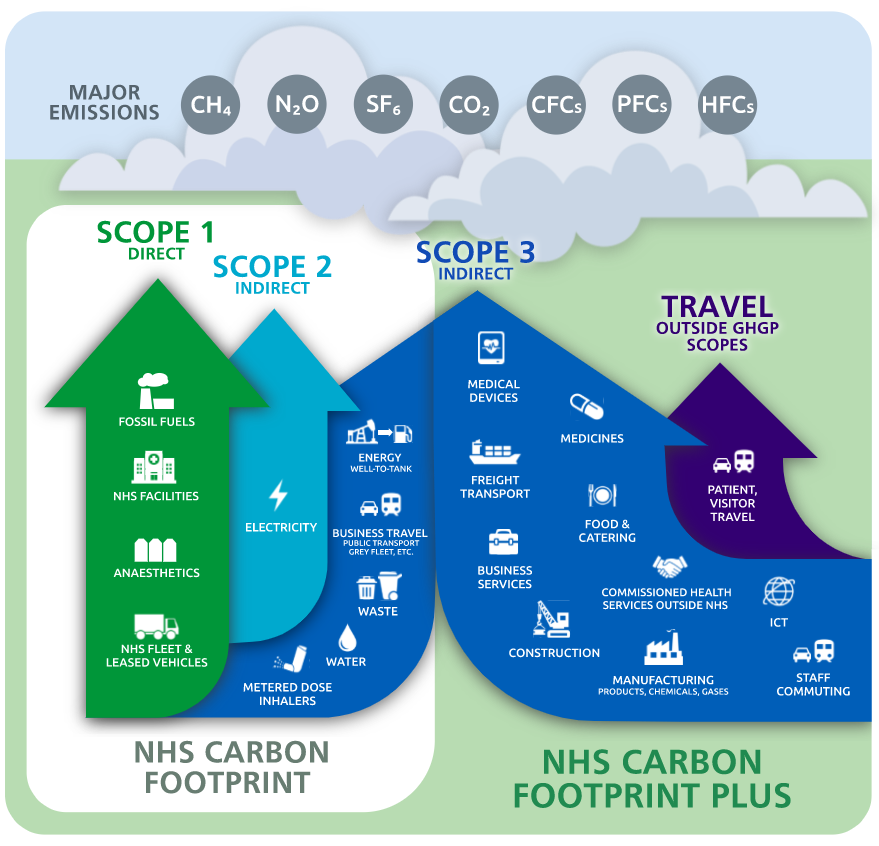
We have data available for several emissions sources from 2010/11. Therefore, we use 2010/11 data as our baseline year.
Comparing the energy and water use from 2010/11 to our 2023/24 data we have reduced these carbon emissions by 25% from our baseline year.
There has been a 14% increase in total gas consumption, when compared with the baseline year, which has resulted from the installation of Combined Heat and Power (CHP) units at BRI and St Luke’s. These units use natural gas to produce heat and electricity, which has contributed to a 64% reduction in the amount of electricity we need to import from the national grid. Historically, CHPs have reduced our operational energy costs and carbon emissions. However, these units are still dependant on fossil fuels, and as such, will need to be replaced as the national electricity grid decarbonises. Our heat decarbonisation plans (HDPs) will support this challenge.
| Emission source | 2010/11 (tCO2e) | 2023/24 (tCO2e) | Percentage change |
|---|---|---|---|
| Grid electricity consumption | 7,090 | 2,549 | -64% |
| Natural gas consumption | 6,894 | 7,850 | 14% |
| Gas oil consumption | 121 | 298 | 146% |
| Water (supplied and treated) | 175 | 48 | 73% |
| Total | 14,280 | 10,745 | -25% |
Note about grid electricity emissions
Grid electricity emissions are reported using ‘location based’ factors in line with NHS guidance. These do not capture the reduction in emissions through the procurement of renewable energy guarantees of origin (REGO) backed electricity.
Our gas oil consumption shows the largest percentage rise (146%) due to an increase in purchased fuel. However, total emissions from this energy source remain below 3%. Emissions from this backup fuel, are significantly lower than the emissions associated with grid electricity and natural gas.
We have worked across our sites to reduce our water usage and associated emissions, as a result we are currently 73% below our baseline.
Contents
©
2026 Bradford Teaching Hospitals NHS Foundation Trust