
This section is about pelvic health and how you can maintain and improve this during pregnancy and the postnatal period.
We offer antenatal classes that cover all the topics below and more.

This section is about pelvic health and how you can maintain and improve this during pregnancy and the postnatal period.
We offer antenatal classes that cover all the topics below and more.


A multiple pregnancy means you are having more than one baby at the same time. This is most commonly twins but may include triplets or more.
The information below focuses on twin and triplet pregnancies.
If you are having more babies, you can still use this information, but you will have an individualised plan of care for your pregnancy.
Multiple pregnancy happens in about one in 60 pregnancies.
Most women with a multiple pregnancy will have a healthy pregnancy and will give birth to healthy babies, however complications are more common.
You will be offered extra antenatal checks and ultrasound scans to make sure that you are well and to monitor your babies closely.
If you have a multiple pregnancy, you are more likely to give birth to your babies prematurely.
You will be advised to give birth in hospital.
Multiple pregnancy is more common as you get older or if you have fertility treatment.
Will my babies be identical or non-identical?
Twins or triplets can be identical (monozygotic) or non-identical (di/tri-zygotic).
Identical twins or triplets have come from one egg, which has been fertilised by one sperm and has then split into two (or three) after fertilisation.
Identical twins or triplets share identical genes, will look the same and be the same sex.
Non-identical twins or triplets have come from different eggs, which have been fertilised by different sperm. If your babies are non-identical, they will have different genes and will be no more similar than any other brothers or sisters.
Chorionicity refers to whether your babies each have their own placenta or whether they share a placenta.
If your babies share a placenta (monochorionic) they are always identical.
If they each have their own placenta (dichorionic/trichorionic) they are more likely to be non-identical but can still be identical.
Chorionicity is checked for at your first ultrasound scan. It is important to know about this because babies who share a placenta have a higher chance of having complications during the pregnancy.
Your first ultrasound scan also checks whether each baby is within their own amniotic sac or whether they share a sac. Babies who share a sac also have a higher chance of complications.
Twins can be:
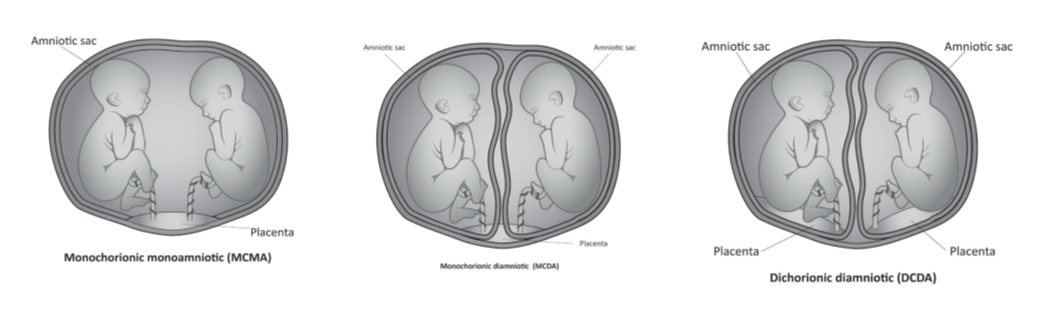
What about triplets and higher order multiples?
Triplets and higher order multiples are formed in the same way but may be in different combinations. Triplets can be trichorionic (each baby has a separate placenta), dichorionic (two of the three babies share a placenta and the third baby has its own placenta), or monochorionic (all three babies share a placenta).
Are identical twins hereditary?
Identical twins are not considered hereditary, they do not run in families.
The occurrence of identical twins is a random event that happens during the early stages of pregnancy.
In non-identical twins family history can play a role.
Most women who are having twins or triplets have a healthy pregnancy and will give birth to healthy babies. However, complications are more common, and you will be offered extra care during your pregnancy.
Problems that many pregnant women experience, such as morning sickness, heartburn, swollen ankles, varicose veins, backache and tiredness, are all more common in multiple pregnancies. These will get better after you have given birth. If you are worried about any of these symptoms please speak to a health professional.
You are also more likely than someone having a single baby to experience more serious problems during your pregnancy.
This may include:
Prematurity
Overall, around 8 in 100 babies (8%) are born prematurely (before 37 weeks). This is more common if you have a multiple pregnancy and can either be because you go into labour early or because your healthcare team recommend that the babies are born early.
If you are pregnant with twins, you have a 60 in 100 (60%) chance of going into labour and giving birth before 37 weeks of pregnancy.
If you are pregnant with triplets, you have a 75 in 100 (75%) chance of going into labour and giving birth before 35 weeks.
Babies born prematurely have an increased chance of health problems, particularly with breathing, feeding and infection. The earlier your babies are born, the more likely this is to be the case. Depending on how early they have been born, they might need to spend time in the neonatal unit or transitional care unit. Wherever possible your babies will be kept together however depending on their individual needs they may need to be cared for separately.
Problems with growth
Having a multiple pregnancy increases the chance that your placenta may not work as well as it should. This can affect the babies’ growth and wellbeing during the pregnancy. Sometimes both babies may be small but more often only one baby is small. If only one baby is affected this is called selective fetal growth restriction (S-FGR).
You will be offered extra ultrasound scans during your pregnancy to check for growth problems:
Twin-to-twin transfusion syndrome (TTTS)
Babies who share a placenta (monochorionic pregnancies) also share the blood supply from the placenta. In around 15 in 100 (15%) monochorionic pregnancies, the blood flow to the babies may be unbalanced.
This is called twin-to-twin transfusion syndrome (TTTS). Triplet pregnancies can also be affected by this.
One baby, the ‘donor’, receives too little blood while the other baby, the ‘recipient’, receives too much blood. It can be mild and may not require any treatment, or it can be serious, in which case you will be offered treatment in a hospital with specialist expertise. You will be monitored with frequent scans for signs of TTTS.
If you notice any of the following you should contact your healthcare professional immediately:
You will be under the care of a specialist healthcare team throughout your pregnancy.
You will have an individualised plan of care for your pregnancy and birth that will include additional visits to the antenatal clinic and extra growth scans for the babies.
You should be given information about what to expect from having a multiple pregnancy and a detailed plan of care at your first appointment with your specialist team. Sometimes referral to a specialised fetal medicine unit, which may be in a different hospital, may be recommended.
You will be advised to give birth in hospital with midwifery and medical support.
When should my babies be born?
The exact timing of birth in a multiple pregnancy will depend on your individual circumstances; however, even if your pregnancy has been uncomplicated, you should be offered a planned birth before your due date.
This is because it has been found to be safer for your babies than continuing with the pregnancy to full term.
The recommended timing of birth is usually:
Your health care team will discuss your birth plan with you.
Your decision as to whether to plan for a vaginal birth (usually after an induction of labour) or a caesarean birth will depend on several factors including:
Twins
Both vaginal birth and caesarean birth have benefits and risks, which will depend on your individual circumstances. Your healthcare professional will discuss these with you to enable you to make an informed choice.
If the baby lying nearest to your cervix (the neck of the womb) is head-down and you have no other complications, then you should be able to plan for a vaginal birth if you choose. The position of the second twin can change after the first baby is born and should not influence how you choose to give birth. More than a third of women having twins who plan a vaginal birth will go on to need a caesarean birth.
If the baby nearest to your cervix is bottom-down (breech) towards the end of the pregnancy, a caesarean birth is usually recommended.
If you have planned to have a caesarean but go into labour naturally before the date of your operation, you should go straight to hospital. Your healthcare team will advise whether the safest option for you is to go ahead with your caesarean as planned or to give birth vaginally. This will depend on the situation at the time.
Monoamniotic twins and triplets
These babies are usually born by caesarean unless you are in very premature labour.
Your own birth preferences are important, and you will have time to discuss these with your healthcare team.
During labour extra measures will be recommended to look after you and your babies.
You will be offered:
There will be numerous health professionals in your room at the time of birth (this is normal practice). There will usually be two midwives, an obstetrician, and doctors and nurses specialising in the care of newborn babies, may also be present.
After your first baby is born, the cord will be clamped and cut but the placenta will stay inside your uterus until your second baby has been born.
Your healthcare team will check whether your second baby is coming head-first or bottom-first by feeling your abdomen, doing an internal examination and by carrying out an ultrasound scan. The second baby is usually born within about 30 minutes to an hour of the birth of the first baby.
In a small number of cases, you may need a caesarean for the birth of the second baby after the first baby has been born vaginally. This is only done if becomes unsafe for your second baby to be born vaginally.
After both your babies and their placenta have been born you will be offered medication to minimise the risk of having heavy bleeding. If you do have heavy bleeding, there is a chance that you may need a blood transfusion.
Feeding will take up a lot of your time in the first few months of your babies’ lives and this is normal.
Whether you breastfeed or formula feed, you’ll need to create a rhythm that suits you and your babies. Some mothers can feed 2 babies at the same time, while some prefer to feed 1 after the other. Some will feed responsively and be led by each baby.
You will be offered advice about feeding your babies during your pregnancy and support with feeding after they are born.
How you choose to feed your babies is a very personal decision. There are many benefits and values to breastfeeding your babies. Gathering information before you have your babies will help you to develop the skills needed to feed your babies and enable you to make informed choices. There is lots of support within the hospital and from your midwife, health visitor and supportive local organisations.
You may want to consider colostrum harvesting (expressing breast milk while you are pregnant, so you have some milk ready to give your babies when they are born). This is an extremely useful skill to gain. Your midwife can teach you how to do this and provide you with collectors. See the links for more information
Breastfeeding is a great way to soothe your babies and helps you build a strong bond with them. There are numerous health benefits and values to breastfeeding and giving breastmilk to babies.
It’s perfectly possible to breastfeed twins, triplets or more. You may like to try a few breastfeeding positions to see which suits you best.
Breastfeeding premature twins
Breast milk is better for premature babies as their gut is immature and it’s easier for them to tolerate and digest. Breast milk also contains proteins and antibodies to protect your babies against infections.
If your babies are very tiny or sick when they’re born, we will recommend that you express to begin with. Your expressed milk may be fed to your babies through a thin tube that passes through the nose and into the stomach.