

A Bradford Teaching Hospitals’ HIV Clinical Nurse Specialist is retiring after a remarkable 36-year career that has mirrored the extraordinary advances in HIV treatment and care.
Beginning his nursing career at the Middlesex Hospital in London in the late 1980s, Simon Corcos joined the Charles Bell HIV ward in 1990. It was a time when effective treatments for HIV did not yet exist and a diagnosis was widely considered a fatal prognosis. The medical landscape was defined by toxic, single-drug therapies, high mortality rates and widespread public stigma.
At that time, we cared for patients with advanced HIV/AIDS knowing that, despite treating opportunistic infections, they would eventually die,” he said. “It was an incredibly difficult time for patients, families and colleagues.
He later moved to the pioneering Kobler Clinic in Chelsea, where some of the first HIV medicines were being trialled. Working as part of a close multidisciplinary team, Simon helped support patients through a period marked by both clinical innovation and profound loss.
Simon continued:
This was really the formative part of my learning and experiencing HIV care with non-hierarchical medical and nursing teams treating symptomatic HIV patients and, of course, sadly a time where we continued to attend many funerals.
This big team effort fostered mutual support and togetherness and hopefully countered the patients’ grim reality with humanity, love, and care.
The arrival of combination triple therapy in 1996 saw a move to his first specialist nurse post in East Surrey with the new drugs helping to transform HIV care and changing the outlook from a terminal illness to a more manageable long-term condition.
While some of the side effects were dreadful, added Simon, Patients survived the illness and started living with HIV having assumed they would die. They could now have the chance to plan for a future and it completely changed the way we treated and cared for people.
After moving to Hebden Bridge in West Yorkshire in 2001, he worked as a police custody nurse, spent a year with GlaxoSmithKline as an HIV adherence nurse in Manchester and was a part-time Clinical Nurse Specialist (CNS) in Lancaster.
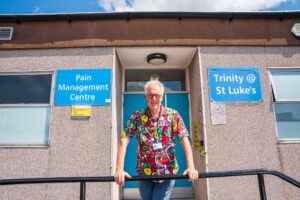
Simon Corcos
Simon joined Bradford Teaching Hospitals in 2006 as an HIV Clinical Nurse Specialist. Over the past 20 years, he has helped care for several thousand patients registered with the HIV service across the city and district, alongside the dedicated multidisciplinary team of which he is part at St Luke’s Hospital.
Today, advances in treatment mean people living with HIV, who comply with their medication, can expect a normal life expectancy. Reflecting on his career, Simon said the greatest privilege had been supporting people through every stage of the changing HIV story.
What an extraordinary change in my working life in HIV treatment and care from a likely death sentence to a normal healthy life expectancy, providing patients take their pills as prescribed.
Stable patients with undetectable HIV blood levels can now attend yearly for blood monitoring, have HIV-free babies and cannot transmit the virus to sexual partners.
In clinic, we try to enjoy our patients’ company, have some fun, but of course be serious about the issues addressing HIV in 2026. Lastly, we advise people that acquire HIV that they haven’t done anything wrong – it may seem a small point, but it is crucial for the patients’ understanding of their chronic viral infection.
Colleagues at Bradford Teaching Hospitals NHS Foundation Trust thanked him for his decades of service to the NHS.
Chief Nurse, Karen Dawber, said:
Simon has dedicated his career to caring for people during some of the most challenging periods in HIV care. From the days when there were few treatment options to today’s life-changing advances in medicine, it’s clear he has been a constant source of expertise, compassion and hope for patients and families.
His career reflects not only the remarkable progress in HIV treatment but also the enduring values of the nursing profession: kindness, courage and a commitment to putting patients first.
I am incredibly grateful for everything Simon has contributed over the past 36 years and wish him a long and happy retirement.