What are T.E.D stockings?

Thrombo-Embolus Deterrent (TED) stockings are also known as Anti-Embolism Stockings or compression stockings. They are specially designed to decrease the risk of you developing a Deep Vein Thrombosis (DVT) or blood clot following surgery for the period which you are less active than normal.

The stockings are made with firm elastic that gives graduated compression to the leg. For the purpose of elective surgery, you will be given stockings that cover below the knee. When you come into hospital, the nursing staff will measure your calf length and width and this will determine what size stockings you are given.
Please always wear slippers, shoes or socks with ant-slip gripping on the bottom when mobilising in your stockings to prevent slipping.

How do T.E.D stockings work?

The stockings squeeze your feet and lower legs, helping to keep the blood circulating around your legs, doing the job your calf muscles would usually do when you are mobile. This makes blood clots in your legs (DVTs) less likely whilst you are less mobile recovering from your surgery.

How long will I need to wear them?

It is important to wear the stockings for as much of the time as possible, day and night, whether in hospital or afterwards at home, until you are back to your usual level of activity.

How do I put the stockings on?

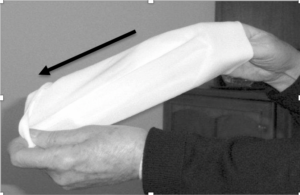
white stocking

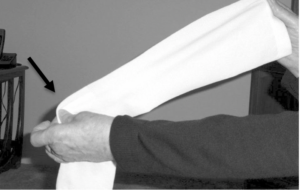
1. Find the heel of the stocking (arrow) as shown in the image above.

white stocking on hand

2. Put your hand into the stocking from the top and go down as far as the heel (arrow).

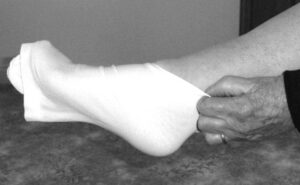
stocking up side down

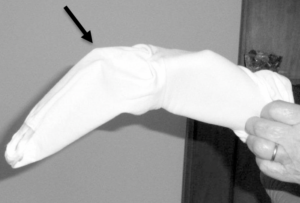
3. Hold the heel with your hand and with the other hand, grip the top of the stocking and turn the stocking inside out as far as possible (pull in direction of arrow).

stocking over foot and heel

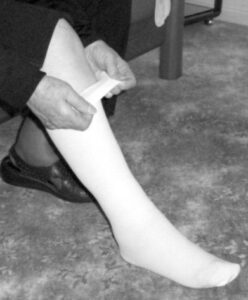
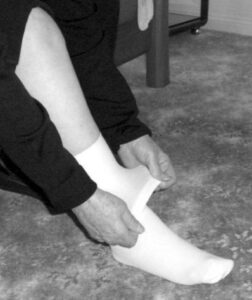
4. Put the stocking over foot and heel. The centre of your heel should be over the heel pocket of the stocking.

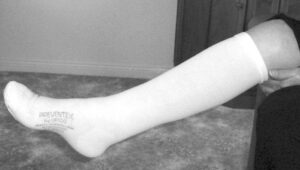
stocking up till knee

5. Pull the stocking over your ankle and calf and up to your knee. Smooth out any spare material making sure the heel is in the heel pocket.

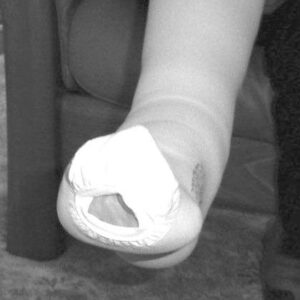
stocking positioned at toes

6. If the stockings have a hole in the foot this should be positioned under the foot, towards the base of the toes.

remove stocking

7. To remove stockings fold over at the top and pull off inside out. Avoid rolling the stocking down the leg since this can make it very tight.

remove stocking

7. To remove stockings fold over at the top and pull off inside out. Avoid rolling the stocking down the leg since this can make it very tight.

How do I avoid problems with blood circulation and my skin when I have to wear the stockings?

  • Do not roll the stockings down, as they will form a tight band around your leg. This can be dangerous as it constricts the blood flow and can cause skin sores. Do not turn down the top of the stocking.
  • Take the stockings off once a day to wash your legs and feet and to check the condition of your skin. Do not leave them off for longer than 30 minutes per day.
  • If you develop pain or discomfort, bruising or blisters or areas where your skin has changed colour you should stop wearing the stockings and seek immediate advice from your doctor or nurse.
Read more

If you develop numbness, pins and needles, pain or soreness in your foot or leg, this may be a sign that the stockings are too tight. Remove the stockings and ask your doctor or nurse for advice.

If you have a rash on your legs or feet, which has appeared whilst you have been wearing the stockings you may have an allergy to the elastic or fibres in the stockings. Remove the stockings and ask your doctor or nurse for advice.

Does everyone have to wear stockings?

If you are unable to put on / remove the stockings or do not have anybody to do this daily at home, inform the nurse and doctor looking after you as you will not be suitable to use these after discharge.

You should not be offered anti-embolism stockings if
  • you have recently had a stroke
  • you have peripheral vascular disease or have had peripheral arterial bypass grafting
  • you have gangrene in your feet or legs or a recent skin graft
  • you have cellulitis or leg/ foot ulcers
  • you have dermatitis or fragile paper thin skin on your legs
  • you have fluid on the lungs caused by heart failure
  • you have an allergy to material used to make the stockings
  • your legs are very swollen or you have limb deformity preventing adequate fit
  • you have peripheral neuropathy or other sensory impairment
  • a good stocking fit cannot be achieved.